Tabs below have links to online readings for Grades K-3 and 3-5.
Sunday, November 11, 2018
Great Reading at Union School in Montpelier
Susan Wilson, our organizer for the reading at Union Elementary School in Montpelier on Thursday, November 8, reports:
"All in all, we read in 24 classrooms with the participation of 21 volunteers, including three Montpelier High School students (seen below) and four parents. I was especially gratified by the enthusiastic support of parents -- even those that reached out but were not able to read in a class today. Thanks so much for your time, support and hospitality. Union is clearly a wonderful and caring learning community. As someone coming in from the outside, I am grateful that I was able to experience your welcoming kindness first hand."
Here's the book table display in the hallway outside the office. The beautiful quilt was made by Janet Burke. Amazing parent volunteer Jenny Sheehan and RER Coordinator Susan Wilson at left:
And here are the Montpelier High School volunteer readers and Susan Wilson. Hurrah for you all!
Wednesday, October 24, 2018
Reading at Doty Memorial Elementary School in Worcester
Today we read in Worcester!
Janet Westervelt read Sneeches in Mr. Larrow's K-1.
Susan Wilson read in Jen Frantz's 1-2.
Janet Van Fleet read in Allison Fayle's 3-4. She started with The Skin I'm in: A First Look at Racism, by Pat Thomas, Lesley Harker (Illustrator). This is a good introduction to the topic of Racism.
Next was a book called Stepping Stones: A Refugee Family’s Journey, by Margriet
Ruurs, illustrated by Syrian artist Nizar Ali Badr. The book was donated to us by the First Church in Barre. The text is in both English and Arabic
Nizar Ali Badr uses stones from the river near his village in Syria. He was born and still resides in Latakia, Syria. In his walks along the seashore near the ancient port city of ugarit, he always admired the stones on the beach. Now he gathers these stones and brings them home to his rooftop stocio, where they become the medium for his art. Nizar has never left his hometown or his country, though in his heart he acoompanies the many Syrians who have been forced to flee their homeland because of ongoing violence.
Janet brought a bucket full of river stones and showed the students how to play a cooperative game called Zen Pebble, in which pairs of students silently take turns adding stones to a collaborative sculpture. The teacher wrote, "My team of learners was incredibly engaged by what you did, and they are still talking about including everyone and respecting differences now (during math and recess!). The game you shared with us was absolutely lovely, and I look forward to borrowing your idea and playing this game with students in the future. What a magical way to admire nature, practice mindfulness, and build community all at once. The students and I loved it."
Lynn Rockwell read Ruth and the Green Book, by Calvin Alexander Ramsey, Floyd Cooper (Illustrator) in Lisa Hanna's 5-6 class.
Ruth was so excited to take a trip in her family's new car! In the early 1950s, few African Americans could afford to buy cars, so this would be an adventure. But she soon found out that black travelers weren't treated very well in some towns. Many hotels and gas stations refused service to black people. Daddy was upset about something called Jim Crow laws... Finally, a friendly attendant at a gas station showed Ruth's family The Green Book. It listed all of the places that would welcome black travelers. With this guidebook--and the kindness of strangers--Ruth could finally make a safe journey from Chicago to her grandma's house in Alabama. Ruth's story is fiction, but The Green Book and its role in helping a generation of African American travelers avoid some of the indignities of Jim Crow are historical fact.
Saturday, October 20, 2018
2018-2019 School Year is Underway
We've already planned and organized two readings in 2018 -- Cabot on October 18 and Doty on October 24.
In November we have two big schools coming up -- Union Elementary School in Montpelier on Thursday, November 8 and Twinfield on Thursday, November 15.
CALLING ALL VOLUNTEERS!
WE NEED ALL HANDS ON DECK FOR THESE READINGS!
Susan Wilson, who is organizing the Union School reading, recently spoke with Union's principal, Michael Barry, giving a great overview of what we do. Have a look, and feel free to share with others.
There will be another training for new readers (the last in 2018) on Saturday, November 3 at Kellogg-Hubbard Library in Montpelier, from 10:00 - noon. Come on over for a refresher, or if you're a new reader!
Saturday, December 2, 2017
Reading at Twinfield Elementary School on December 1, 2017
This was our last reading in 2017. We are taking a break during the winter, and will start reading again in April, 2018. There will be another training for people who would like to join us as readers in the spring session, so let us know (email one of the organizers at the right) if you'd like to be notified about the next training! We love having new readers join us.
We had a great morning reading at Twinfield. The school was enthusiastic about having Reading to End Racism, and the wonderful guidance counselor (who was our contact at the school), Anthony Popoli, arranged a great display of some of our books right across from the entrance to the school. It looks like he had some student help making the festive sign!
We realized it was the 62nd anniversary of the arrest of Rosa Parks! We had eleven great volunteer readers in grades K-6. Here are some of the books and readers we haven't profiled before:
Rachel Rudi read Let's Talk About Race, by Julius Lester, illustrated by Karen Barbour, in a first grade class.
This is the first time we've had a former student read at a school -- Rachel graduated from Twinfield!
She said she chose this book because she couldn't remember there ever being a conversation about race when she was a student, and she felt it was really important to talk about. Unless we bring it out and examine it and let people talk about their experiences and thoughts and feelings, it will all still be there in some hidden place, festering under the surface.
Janet Van Fleet Read Sitti's Secrets by Naomi Shihab Nye, illustrated by Nancy Carpenter, in a 3-4 grade class.
Mona lives in the United States, but her grandmother, her Sitti, lives in a small Palestinian village on the other side of the earth, Mona says, "When our sky grows dark, the sun is peeking through her [grandmother's] window and brushing the bright lemons on her lemon tree." Once Mona went to visit her. They couldn't speak each other's language (Sitti only speaks Arabic and Mona only speaks English), so sometimes Mona's father translates for them. But mostly they make up their own language of gestures.
Janet told the class that everybody in our country has a family that came from somewhere else in the world if you go back through the generations. Many people wanted to come to the United States because of the opportunities here. Other people were forced to come here, like the slaves who were brought to our country from Africa. But in Janet's family, her sister left the United States and moved to Australia many years ago, moving out rather than in. People have been moving around the planet since there have been people, and it's good to be able to move to a new place and be welcomed.
Leda Schubert read Boycott Blues: How Rosa Parks Inspired a Nation, by Andrea Davis Pinkney, illustrated by Brian Pinkney, to a 3-4 grade class, in honor of the anniversary of Rosa Parks' arrest. She brought her guitar and taught the class some songs from the civil rights movement -- "Ain't Gonna Let Nobody Turn Me Round," "We Shall Not Be Moved," and the chorus of "We Shall Overcome" with the principal, whose father worked polls in the south for decades.
She also shared her own book Trailblazer : The Story of Ballerina Raven Wilkinson, illustrated by Theodore Taylor -- coming out in January! It is the story of
Raven Wilkinson, the first African American woman to dance for a major classical ballet company and an inspiration to Misty Copeland. From the time she was a little girl, all Raven Wilkinson wanted to do was dance. On her ninth birthday, her uncle gifted her with ballet lessons, and she completely fell in love with dance. While she was a student at Columbia University, Raven auditioned for the Ballet Russe de Monte Carlo and was finally accepted on her third try, even after being told she couldn't dance with them because of her skin color.
Rachel Cogbill read Ruth and the Green Book, by Calvin Alexander Ramsey with Gwen Strauss, illustrated by Floyd Cooper, to a 3-4 grade class.
Ruth was so excited to take a trip in her family's new car! In the early 1950s, few African Americans could afford to buy cars, so this would be an adventure. But she soon found out that black travelers weren't treated very well in some towns. Many hotels and gas stations refused service to black people. Daddy was upset about something called Jim Crow laws...Finally, a friendly attendant at a gas station showed Ruth's family The Green Book. It listed all of the places that would welcome black travelers. With this guidebook--and the kindness of strangers--Ruth could finally make a safe journey from Chicago to her grandma's house in Alabama. Ruth's story is fiction, but The Green Book and its role in helping a generation of African American travelers avoid some of the indignities of Jim Crow are historical fact.
Charlottte Faulstick read parts of CHILDREN Just Like Me: A new celebration of children around the world, to a 5-6 grade class. The book profiles 44 children and their daily lives, showing the many ways children are different and the many ways they are the same, no matter where they live.
She also read Trail of Tears by Joseph Bruchac. In 1838, settlers moving west forced the great Cherokee Nation, and their chief John Ross, to leave their home land and travel 1,200 miles to a new settlement in Oklahoma, a terrible journey known as the Trail of Tears.
Susan Wilson read The Case for Loving: The Fight for Interracial Marriage, by Selina Alko, illustrated by Sean Qualls and Selina Alko, in a 5-6 grade class.
This is the story of one brave family: Mildred Loving,
Richard Perry Loving, and their three children. It is the story of how
Mildred and Richard fell in love, and got married in Washington, D.C.
But when they moved back to their hometown in Virginia, they were
arrested (in dramatic fashion) for violating that state's laws against
interracial marriage. The Lovings refused to allow their children to get
the message that their parents' love was wrong and so they fought the
unfair law, taking their case all the way to the Supreme Court - and
won!
We had a great morning reading at Twinfield. The school was enthusiastic about having Reading to End Racism, and the wonderful guidance counselor (who was our contact at the school), Anthony Popoli, arranged a great display of some of our books right across from the entrance to the school. It looks like he had some student help making the festive sign!
We realized it was the 62nd anniversary of the arrest of Rosa Parks! We had eleven great volunteer readers in grades K-6. Here are some of the books and readers we haven't profiled before:
Rachel Rudi read Let's Talk About Race, by Julius Lester, illustrated by Karen Barbour, in a first grade class.
This is the first time we've had a former student read at a school -- Rachel graduated from Twinfield!
She said she chose this book because she couldn't remember there ever being a conversation about race when she was a student, and she felt it was really important to talk about. Unless we bring it out and examine it and let people talk about their experiences and thoughts and feelings, it will all still be there in some hidden place, festering under the surface.
Janet Van Fleet Read Sitti's Secrets by Naomi Shihab Nye, illustrated by Nancy Carpenter, in a 3-4 grade class.
Mona lives in the United States, but her grandmother, her Sitti, lives in a small Palestinian village on the other side of the earth, Mona says, "When our sky grows dark, the sun is peeking through her [grandmother's] window and brushing the bright lemons on her lemon tree." Once Mona went to visit her. They couldn't speak each other's language (Sitti only speaks Arabic and Mona only speaks English), so sometimes Mona's father translates for them. But mostly they make up their own language of gestures.
Janet told the class that everybody in our country has a family that came from somewhere else in the world if you go back through the generations. Many people wanted to come to the United States because of the opportunities here. Other people were forced to come here, like the slaves who were brought to our country from Africa. But in Janet's family, her sister left the United States and moved to Australia many years ago, moving out rather than in. People have been moving around the planet since there have been people, and it's good to be able to move to a new place and be welcomed.
Leda Schubert read Boycott Blues: How Rosa Parks Inspired a Nation, by Andrea Davis Pinkney, illustrated by Brian Pinkney, to a 3-4 grade class, in honor of the anniversary of Rosa Parks' arrest. She brought her guitar and taught the class some songs from the civil rights movement -- "Ain't Gonna Let Nobody Turn Me Round," "We Shall Not Be Moved," and the chorus of "We Shall Overcome" with the principal, whose father worked polls in the south for decades.
She also shared her own book Trailblazer : The Story of Ballerina Raven Wilkinson, illustrated by Theodore Taylor -- coming out in January! It is the story of
Raven Wilkinson, the first African American woman to dance for a major classical ballet company and an inspiration to Misty Copeland. From the time she was a little girl, all Raven Wilkinson wanted to do was dance. On her ninth birthday, her uncle gifted her with ballet lessons, and she completely fell in love with dance. While she was a student at Columbia University, Raven auditioned for the Ballet Russe de Monte Carlo and was finally accepted on her third try, even after being told she couldn't dance with them because of her skin color.
Rachel Cogbill read Ruth and the Green Book, by Calvin Alexander Ramsey with Gwen Strauss, illustrated by Floyd Cooper, to a 3-4 grade class.
Ruth was so excited to take a trip in her family's new car! In the early 1950s, few African Americans could afford to buy cars, so this would be an adventure. But she soon found out that black travelers weren't treated very well in some towns. Many hotels and gas stations refused service to black people. Daddy was upset about something called Jim Crow laws...Finally, a friendly attendant at a gas station showed Ruth's family The Green Book. It listed all of the places that would welcome black travelers. With this guidebook--and the kindness of strangers--Ruth could finally make a safe journey from Chicago to her grandma's house in Alabama. Ruth's story is fiction, but The Green Book and its role in helping a generation of African American travelers avoid some of the indignities of Jim Crow are historical fact.
Charlottte Faulstick read parts of CHILDREN Just Like Me: A new celebration of children around the world, to a 5-6 grade class. The book profiles 44 children and their daily lives, showing the many ways children are different and the many ways they are the same, no matter where they live.
She also read Trail of Tears by Joseph Bruchac. In 1838, settlers moving west forced the great Cherokee Nation, and their chief John Ross, to leave their home land and travel 1,200 miles to a new settlement in Oklahoma, a terrible journey known as the Trail of Tears.
Susan Wilson read The Case for Loving: The Fight for Interracial Marriage, by Selina Alko, illustrated by Sean Qualls and Selina Alko, in a 5-6 grade class.
Sunday, November 19, 2017
Reading at Barre City Elementary School on November 14, 2017
Debby Gale did a stellar job organizing 28 readers to read for the K-4 classes at Barre Town Elementary School! Their wonderful principal, James Taffel, welcomed us and took this photograph of the group before people headed out to their classrooms.
Because so much was going on in a short period of time, we're unable to describe the activities readers did in their various classrooms, but we can tell you that it was a very busy morning! Here are a few images from the classrooms:
Above: Ellen Halperin and Barbara Bendix in a combined third grade classroom.
Above: Kevin Chu reads in a first grade classroom.
Some of our photographs of individual readers and their books didn't turn out, but this is a good sampling of the wonderful people who read, and their books:
![]() | |||
| Sally Hobart, The Other Side |
![]() | |
| Manny Tejeda, All the Colors of the Earth |
![]() |
| Marilyn May, Testing the Ice |
![]() |
| Liz Hamlin-Volz, Teammates |
![]() |
| Rachel Cogbill, Jackie's Bat |
![]() |
| Janet Westervelt, Black is Brown |
![]() |
| Debby Gale, Skin Again |
![]() |
| Kevin Chu, Teammates |
![]() | |
| Abigail Stockman, Aunt Flossie's Hats (and Crab Cakes Later) |
![]() |
| Beth Ann Maier, Sneetches |
![]() |
| Charlotte Faulstick, Navajo Long Walk |
![]() |
| Barbara Bendix and Ellen Halperin, Henry Aaron's Dream |
![]() |
| Cynthia Ross, My Name is Sangoel |
![]() |
| Ellen Bresler, Lucia the Luchadora and Cherries and Cherry Pits |
![]() |
| Georgia Landau, Across the Alley |
![]() |
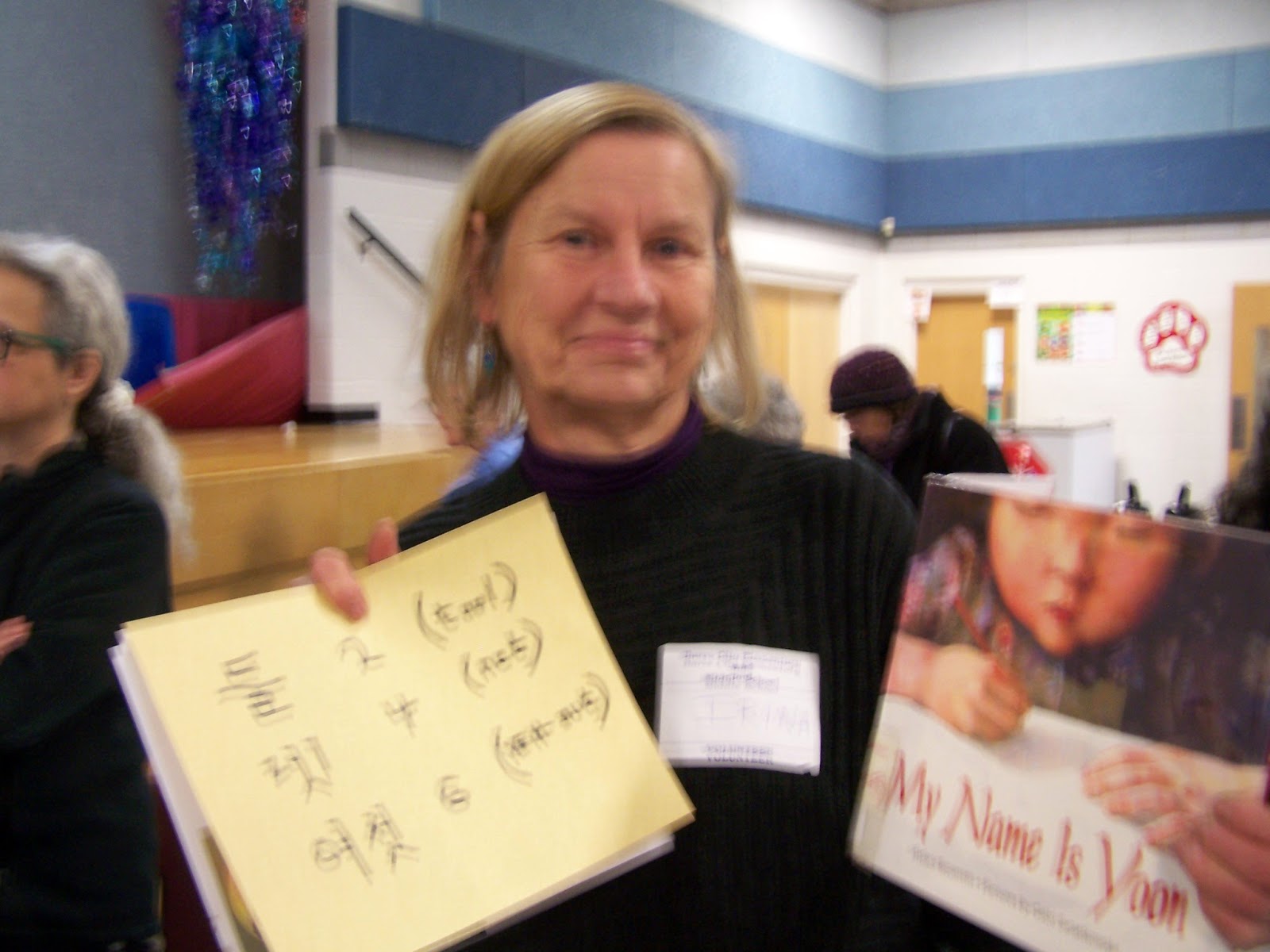
| Irina Markova, My Name is Yoon |
![]() |
| Jean Jersey, This is the Dream |
![]() |
| Shana Margolin, Walking to the Bus-Rider Blues |
![]() |
| Nate Ball, Say Something |
![]() |
| Becky Bowen, Let's Talk About Ruby Bridges |
Saturday, November 11, 2017
Paul Erlbaum Reads "Sneetches"

Paul Erlbaum read Dr. Seuss's The Sneetches to a kindergarten class at Rumney. You can see a similar reading he did, and the way he engaged the class here.
Joseph Gainza Reads "Jackie's Bat"
Narrated by the Brooklyn Dodgers' white batboy, Joey, Lorbiecki's (Sister Anne's Hands
) heartwarming tale set in 1947 tells two parallel stories. The first
is Jackie Robinson's difficult but ultimately triumphant first season in
the major leagues, and the other is Joey's challenging, but also
triumphant, battle against his own racism. With understated simplicity,
Joey recounts the numerous indignities Robinson endures: taunts from
opposing teams, pitchers aiming at him, hate mail, separate hotels and
some insults inflicted by the batboy himself (e.g., Joey cleans the
shoes of every player except Robinson because, the boy thinks to
himself, "Pops says it ain't right,/ a white boy serving a black man").
Robinson confronts Joey: "There's people out there who don't/ treat me
as a man 'cause my skin is black/.... They don't know what a man is."
Joey chronicles Robinson's gradual progression from outsider to "one of
the guys" as his teammates start defending and working with him.
The final scenes depict
Robinson offering Joey his hand to shake, "one Dodger to another," and
Pops wearing an "I'm for Jackie" button, saying, "That man's earned his
place in history." These moments give added emotional weight to this
straightforward but often moving re-imagining of how an American hero's
struggle and achievement helped transform a nation.
In introducing the book, Joseph tells that he grew up in Brooklyn and loved the Dodgers. But a more important story was about Joseph's own father, who worked on the docks. In his first job, unloading ballast from a big ship, he was part of a long line of men who handed the rough ballast stones hand over hand from the ship's hold, up the stairs, and onto the dock. Joseph's father worked next to an older African-American man, who had a worn and torn pair of gloves on his hands, while Joseph's father's hands were getting all ripped up. At a pause in the movement of stones, the man drew out a pair of new gloves from his back pocket and said to Joseph's father, "Here, son, wear these." Joseph's father said he couldn't take the man's new gloves, but he insisted. Joseph said his father never forgot that, and he never heard his father say anything derogatory about black people, and their home was one in which all people were respected. What Joseph drew from this experience is that a small act of kindness can have huge consequences.
Georgia Landau Reads "My Name is Bilal"
A young boy wrestles
with his Muslim identity in this picture book for children written by
Dr. Asma Mobin-Uddin, with illustrations by Barbara Kiwak.
When Bilal and his sister Ayesha move with their family, they have to attend a new school. They soon find out that they may be the only Muslim students there. When Bilal sees his sister bullied on their first day, he worries about being teased himself, and thinks it might be best if his classmates didn’t know that he is Muslim. Maybe if he tells kids his name is Bill, rather than Bilal, then they would leave him alone. Mr. Ali, one of Bilal's teachers and also Muslim, sees how Bilal is struggling. He gives Bilal a book about the first person to give the call to prayer during the time of the Prophet Muhammad. That person was another Bilal: Bilal Ibn Rabah. What Bilal learns from the book forms the compelling story of a young boy grappling with his identity. (Summary from goodreads)
Thursday, November 2, 2017
Rachel Cogbill Reads "Amazing Grace"
Rachel read Amazing Grace to the kindergarten. (See here for a description of the book). Rachel's summary:Grace wants to be Peter Pan in the class play, but one classmate says she can't be because Peter Pan is a boy, and another says she can't be Peter Pan because she is black. Her Nana says Grace can be anything she puts her mind to, and in the end her classmates agree! The play is a great success!
We believe it is essential to provide children with diverse role models, in terms of skin color, cultural heritage, ability, national origin, etc. This book is a lovely example of this perspective.
Activity: Rachel created a booklet with an image of the book's cover on the front, the name of the class, and a line stating "Read aloud during the Reading to End Racism Day." Inside the booklet, it said "Grace can be anything she wants to be, and so can I!" There was a page for each student to draw a picture and write what he or she wanted to be. This boy wanted to be a baker! This activity provides a great little brochure that students can take home to talk with their families about.
Bob Fisher Reads "Teammates"
Bob Fisher read Teammates to a 5-6 class. In an introduction to his reading, Bob told two personal stories about why he cares about racism and its effects. He said that when he was in high school, his girlfriend was African-American. Her father was a postal worker and a diabetic. One day he had a diabetic crisis, and went to the hospital for treatment, but collapsed inside. The hospital staff left him on the floor, assuming that he was drunk. He didn't receive treatment, and he died.
He also told that someone in his neighborhood had a bottle of wine stolen, and Bob was accused of the theft because of his inter-racial relationship, which was regarded as suspect and anti-social. These are the effects of prejudice and stereotyping.
Susan Wilson Reads Two Books About Shoes to Grades 1-2
Susan Wilson read Those Shoes and New Shoes (see previous post here for similar reading) .

Here a student traces around her foot before writing her list of Wants and Needs.
Amazingly, as we left the room, there was a photograph on the door of a group of African youngsters sitting in a circle with NO shoes on, creating a wonderful design with their feet!

Here a student traces around her foot before writing her list of Wants and Needs.
Amazingly, as we left the room, there was a photograph on the door of a group of African youngsters sitting in a circle with NO shoes on, creating a wonderful design with their feet!
Subscribe to:
Posts (Atom)